Choosing the right Enterprise Resource Planning (ERP) platform is one of the most important decisions for any growing business. If you’ve decided to implement Odoo, the next question is equally important: Should you choose Odoo Community or Odoo Enterprise?
Many businesses struggle with this decision because both editions are built on the same core platform. They share a user-friendly interface, modular architecture, and the ability to manage multiple business operations from a single system. However, the differences between the two versions can significantly impact your company’s productivity, scalability, and long-term costs.
Whether you’re a startup looking for a cost-effective ERP or an established enterprise seeking advanced automation, understanding the strengths and limitations of each edition will help you make the right investment.
In this guide, we’ll compare Odoo Community vs Enterprise in detail, covering features, pricing, customization, support, security, scalability, and ideal use cases. By the end, you’ll know which version best fits your business goals.
What is Odoo?
Odoo is one of the world’s most popular open-source ERP platforms. It allows businesses to manage multiple operations through integrated applications, including:
- CRM
- Sales
- Inventory
- Accounting
- Manufacturing
- Human Resources
- Purchasing
- Project Management
- Marketing Automation
- Helpdesk
- Website Builder
- eCommerce
Instead of using different software for each department, Odoo brings everything together into one centralized platform. This improves collaboration, reduces duplicate data, and provides better visibility into business performance.
The platform is available in two editions:
- Odoo Community
- Odoo Enterprise
While both versions share the same foundation, they serve different business needs.
Understanding Odoo Community Edition
The Odoo Community Edition is the free, open-source version of Odoo. Businesses can download, install, and customize it without paying software licensing fees.
This edition provides the essential ERP functionalities needed to manage everyday business operations.
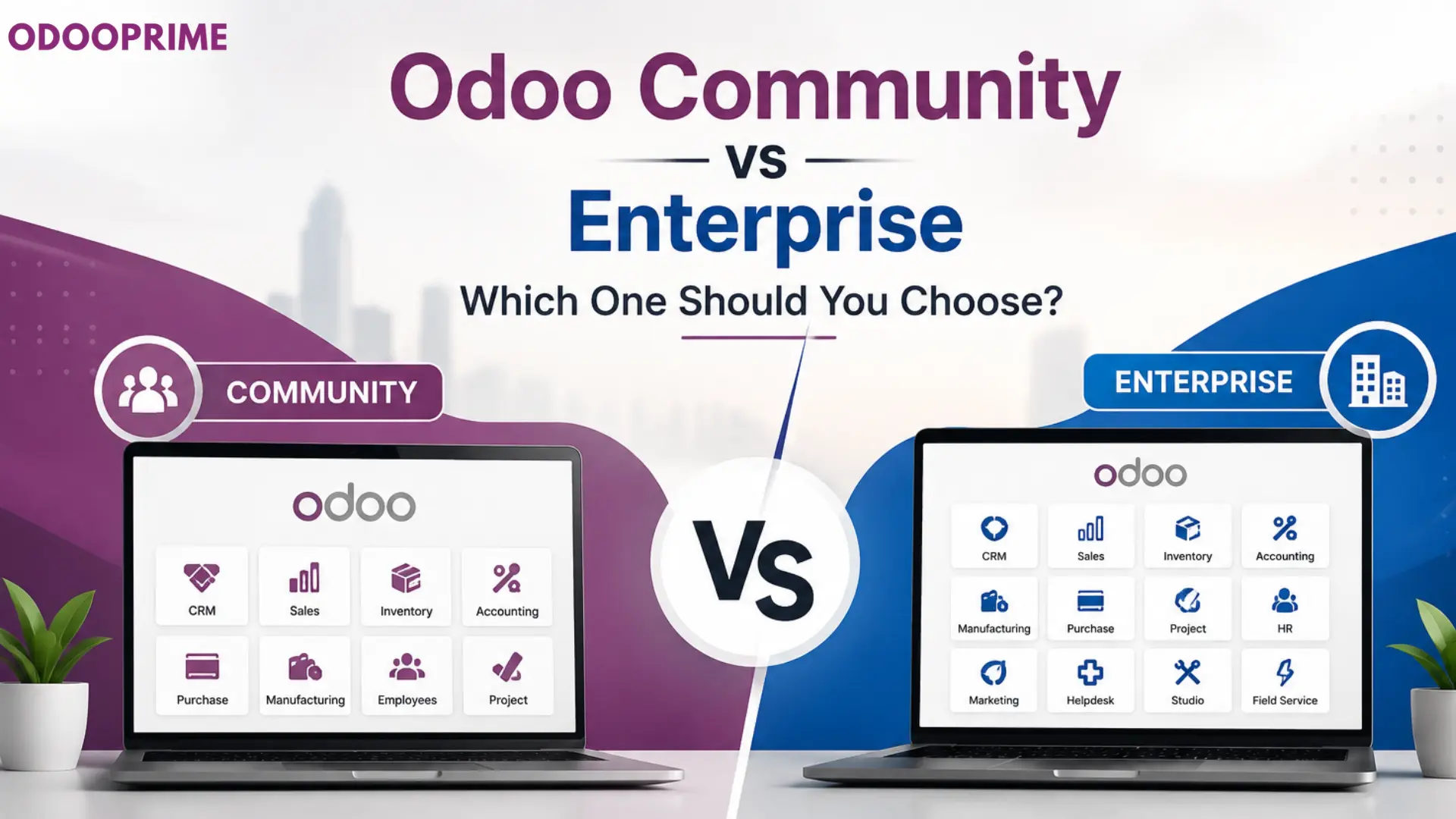
Key Features of Odoo Community
- CRM
- Sales Management
- Purchase Management
- Inventory Management
- Manufacturing
- Accounting (basic functionality)
- Employee Management
- Project Management
- Timesheets
- Basic Reporting
Since the source code is openly available, developers can modify the platform according to business requirements.
What is Odoo Enterprise Edition?
The Odoo Enterprise Edition includes everything available in the Community version along with many premium features designed for businesses that need advanced automation, analytics, and enterprise-grade capabilities.
It comes with an official subscription from Odoo and offers additional applications, cloud hosting options, continuous updates, and professional technical support.
Additional Enterprise Features
- Advanced Accounting
- Document Management
- Helpdesk
- Field Service
- Studio (No-Code Customization)
- PLM (Product Lifecycle Management)
- Quality Management
- Maintenance
- Marketing Automation
- VoIP Integration
- Digital Signatures
- Spreadsheet Integration
- Advanced Dashboards
- Rental Management
- Appointments
- Knowledge Management
- Approval Workflow
- Employee Appraisals
Enterprise users also receive regular upgrades and security patches directly from Odoo.
Odoo Community vs Enterprise: Feature Comparison
Let’s compare the two editions across the most important business areas.
| Feature | Community | Enterprise |
|---|---|---|
| Open Source | ✅ | ❌ |
| License Fee | Free | Paid |
| CRM | ✅ | ✅ |
| Sales | ✅ | ✅ |
| Inventory | ✅ | ✅ |
| Manufacturing | ✅ | ✅ |
| HR | Basic | Advanced |
| Accounting | Basic | Full Features |
| Marketing Automation | ❌ | ✅ |
| Helpdesk | ❌ | ✅ |
| Field Service | ❌ | ✅ |
| Studio | ❌ | ✅ |
| Document Management | ❌ | ✅ |
| Mobile Experience | Basic | Enhanced |
| Official Support | ❌ | ✅ |
| Odoo.sh Hosting | ❌ | ✅ |
| Regular Upgrades | Limited | Included |
While Community offers strong core ERP functionality, Enterprise provides a more complete digital business management solution.
Pricing Comparison
Cost is one of the biggest deciding factors.
Odoo Community
The software itself is completely free.
However, businesses should budget for:
- Implementation
- Customization
- Hosting
- Development
- Maintenance
- Security
- Technical support
Although there are no licensing costs, custom development expenses can increase over time depending on project complexity.
Odoo Enterprise
Enterprise requires an annual or monthly subscription.
The subscription generally includes:
- Official software license
- Continuous updates
- Security patches
- Access to premium applications
- Technical support
- Cloud hosting options
While the initial investment is higher, many businesses find that the built-in features reduce the need for extensive custom development.
Customization Capabilities
Customization is one of Odoo’s strongest advantages.
Community Edition
Community offers complete access to the source code.
Businesses can:
- Develop custom modules
- Modify existing features
- Build third-party integrations
- Create custom workflows
However, every customization requires experienced developers.
Enterprise Edition
Enterprise supports both developer-based customization and low-code configuration through Odoo Studio.
With Studio, users can:
- Add custom fields
- Create forms
- Design workflows
- Build reports
- Customize menus
- Modify screens
This allows many business users to make changes without writing code.
Performance and Scalability
As businesses grow, ERP performance becomes increasingly important.
Community Edition
Community performs well for:
- Small businesses
- Local companies
- Businesses with limited users
- Basic ERP implementations
Larger deployments often require additional optimization and server management.
Enterprise Edition
Enterprise is optimized for:
- Large organizations
- Multi-company operations
- Multi-warehouse management
- International businesses
- High transaction volumes
- Large user bases
Its advanced architecture ensures better performance under heavy workloads.
Support and Maintenance
Support is another major difference.
Community Edition
Support typically comes from:
- Internal IT teams
- ERP consultants
- Odoo implementation partners
- Open-source community forums
Businesses are responsible for maintaining their systems.
Enterprise Edition
Enterprise customers receive:
- Official technical support
- Regular software updates
- Security improvements
- Bug fixes
- Version upgrade assistance
This minimizes downtime and reduces operational risks.
Security and Compliance
ERP systems store sensitive business information, making security essential.
Community
Security depends on:
- Server configuration
- Internal maintenance
- Developer expertise
- Manual updates
If updates are delayed, businesses may become vulnerable to security risks.
Enterprise
Enterprise includes:
- Official security patches
- Regular updates
- Improved authentication features
- Enhanced access controls
- Better enterprise-grade compliance tools
This provides greater peace of mind for businesses handling financial and customer data.
Which Businesses Should Choose Odoo Community?
Community is an excellent option for businesses that:
- Are startups with limited budgets
- Have experienced developers
- Need basic ERP functionality
- Want complete control over customization
- Prefer open-source software
- Can manage hosting independently
For technically skilled organizations, Community provides tremendous flexibility at a low software cost.
Who Should Choose Odoo Enterprise?
Enterprise is ideal for businesses that:
- Need advanced ERP capabilities
- Require official technical support
- Want faster implementation
- Need sophisticated reporting
- Operate across multiple locations
- Manage complex accounting processes
- Plan for long-term business growth
Companies that depend heavily on automation typically achieve a faster return on investment with Enterprise because many advanced features are available immediately.
Pros and Cons of Odoo Community
Advantages
- Free software license
- Fully open source
- Highly customizable
- Large developer community
- Flexible deployment
- Lower initial investment
Limitations
- Limited advanced applications
- No official Odoo support
- Manual upgrades
- Fewer productivity tools
- More developer dependency
Pros and Cons of Odoo Enterprise
Advantages
- Complete business suite
- Official support
- Premium applications
- Better reporting
- Faster deployment
- Enhanced security
- Easier customization with Studio
- Continuous updates
- Better mobile usability
Limitations
- Subscription costs
- Licensing based on users
- Some advanced customization may still require development expertise
Migration from Community to Enterprise
One of Odoo’s biggest advantages is that businesses can start with Community and later migrate to Enterprise as their needs evolve.
A successful migration generally includes:
- Database assessment
- Module compatibility review
- Data cleanup
- Custom module validation
- User testing
- Final deployment
Working with an experienced implementation partner helps ensure minimal disruption during the migration process.
How to Make the Right Choice
Before selecting an edition, consider these questions:
- What is your available ERP budget?
- How many users will access the system?
- Do you need advanced automation?
- Will you require official support?
- How much customization is necessary?
- Do you expect rapid business growth?
- Do you have an internal development team?
If your organization mainly needs standard ERP functions and has technical expertise, Community can be a practical choice.
If you prioritize scalability, premium applications, built-in automation, and vendor-backed support, Enterprise is often the better long-term investment.
Why Work with an Experienced Odoo Partner?
Selecting the right Odoo edition is only part of the implementation journey. A successful ERP project also depends on proper planning, configuration, customization, user training, and ongoing support.
Partnering with an experienced odoo service provider in Dubai can help you:
- Analyze your business requirements
- Recommend the right Odoo edition
- Customize modules to fit your workflows
- Integrate third-party applications
- Migrate data securely
- Train your employees
- Provide long-term technical support and upgrades
A knowledgeable implementation partner can reduce deployment time, avoid costly mistakes, and ensure your ERP system delivers measurable business value.
Conclusion
Choosing between Odoo Community and Enterprise ultimately depends on your business size, operational complexity, budget, and long-term goals. Both editions are built on the same robust ERP platform, but they serve different types of organizations.
Odoo Community is an excellent choice for startups, small businesses, and companies with in-house technical expertise that want a flexible, open-source ERP without licensing costs. It offers the essential tools needed to manage daily operations while allowing unlimited customization through its open codebase.
Odoo Enterprise, on the other hand, is designed for businesses that need advanced functionality, built-in automation, official support, stronger security, and a faster path to digital transformation. Although it requires a subscription, the additional features and reduced dependency on custom development often make it a worthwhile investment for growing and established organizations.
Before making your decision, evaluate your current requirements as well as your future growth plans. An ERP system should not only address today’s challenges but also support your business as it expands. With the right edition and the guidance of an experienced implementation partner, Odoo can become the foundation for greater efficiency, smarter decision-making, and sustainable business growth.