What is Traditional ERP?
Traditional ERP systems are large, centralized software platforms.
They manage finance, HR, supply chain, and operations in one system.
Most traditional ERPs are on-premise.
This means businesses install and maintain them on internal servers.
On-premise vs Cloud
Traditional ERP relies heavily on on-premise infrastructure.
This leads to:
- High upfront costs
- Complex setup
- Long deployment cycles
Updates are slow.
Scaling requires hardware upgrades.
Maintenance depends on internal IT teams or expensive vendors.
These systems work well for large enterprises.
But they often lack flexibility.
They are rigid.
Customization is costly.
Integration with modern tools is limited.
What is Odoo ERP?
Odoo is a modern, modular ERP system.
It offers apps for:
- CRM
- Accounting
- Inventory
- HR
- eCommerce
It is available in cloud and on-premise versions.
Modular vs Monolithic Systems
Odoo uses a modular structure.
Businesses can start small.
Then add features as needed.
This reduces initial investment.
It also speeds up implementation.
Unlike traditional ERP, Odoo evolves with the business.
Frequent updates keep the system current.
Integration with third-party tools is easier.
Key Differences Between Odoo and Traditional ERP
Odoo and traditional ERP differ in architecture, cost, and usability.
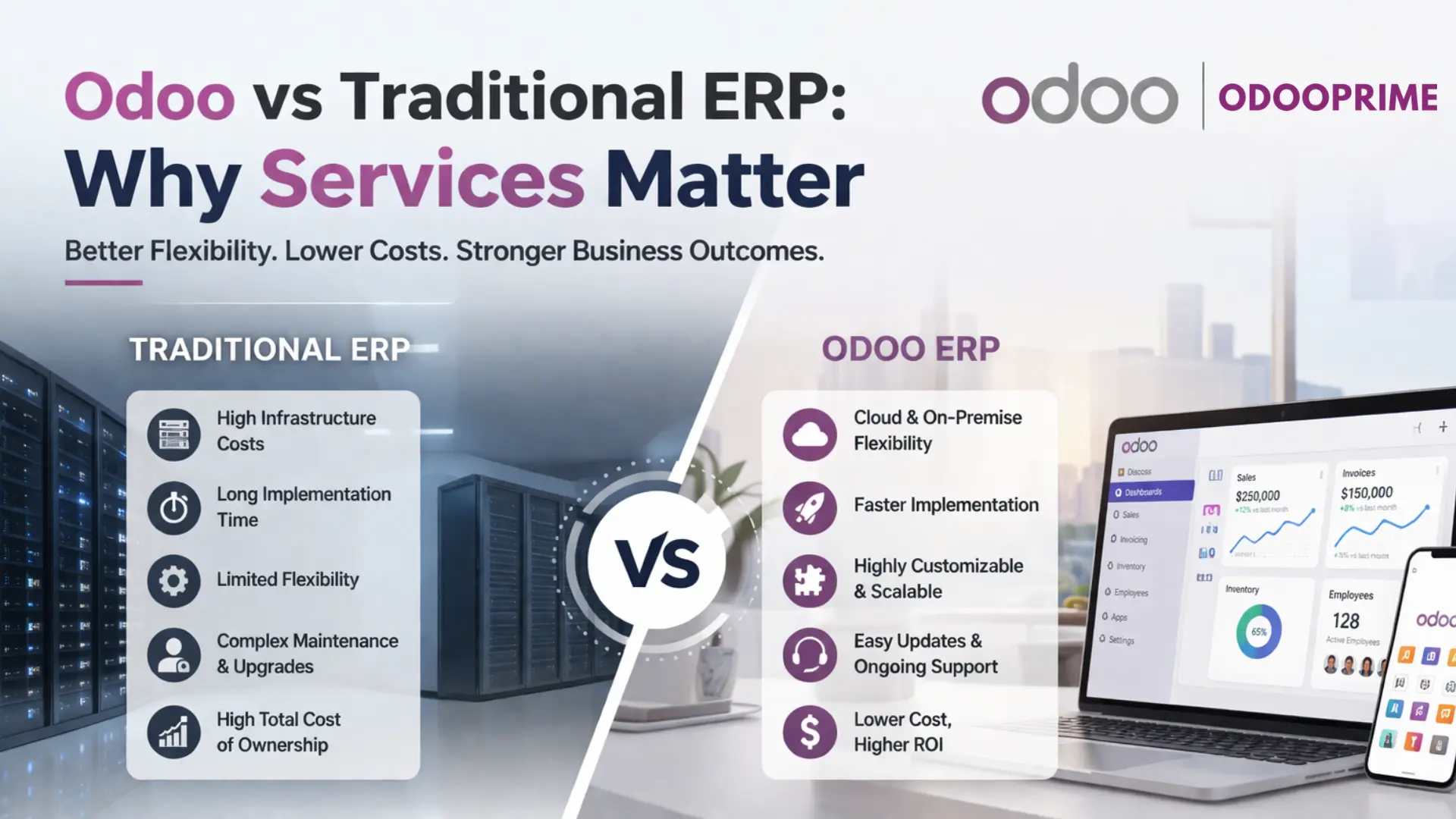
Comparison Overview
- Deployment:
Odoo = Cloud + On-premise
Traditional ERP = Mostly on-premise - Cost:
Odoo = Lower upfront cost
Traditional ERP = High licensing + hardware - Flexibility:
Odoo = High
Traditional ERP = Low - Implementation Time:
Odoo = Faster
Traditional ERP = Slow - User Experience:
Odoo = Modern interface
Traditional ERP = Complex
Support and Maintenance
Traditional ERP requires continuous maintenance.
Costs increase over time.
Odoo offers simpler updates.
Support services are more accessible.
Why ERP Services Matter More Than Software
Software alone does not guarantee success.
Services define outcomes.
ERP services include:
- Implementation
- Customization
- Integration
- Training
- Support
Support and Maintenance
Without proper support:
- Systems fail
- Users struggle
- ROI drops
Good services ensure:
- Smooth adoption
- Faster ROI
- Better performance
ERP success depends more on execution than software choice.
Implementation: The Real Success Factor
ERP implementation is complex.
Poor implementation leads to failure.
Common issues:
- Data migration errors
- Poor user training
- Lack of planning
ROI and Long-Term Value
Proper implementation delivers:
- Faster go-live
- Reduced downtime
- Improved efficiency
Odoo implementation is faster due to modular design.
But expert services are still required.
Choosing the right partner is critical.
Customization and Scalability
Every business has unique needs.
ERP must adapt.
Industry-Specific Customization
Odoo allows deep customization.
Businesses can:
- Modify workflows
- Add features
- Integrate tools
Traditional ERP customization is expensive.
It often requires vendor involvement.
Scalability Benefits
Odoo scales easily.
Add modules as business grows.
No need for full system overhaul.
Cost Comparison: Odoo vs Traditional ERP
Cost is a major decision factor.
Traditional ERP includes:
- Licensing fees
- Hardware costs
- Maintenance charges
Odoo offers:
- Subscription pricing
- Lower setup cost
- Flexible scaling
Hidden Costs
Traditional ERP often has hidden costs:
- Upgrade fees
- Customization charges
- Long-term contracts
Odoo reduces these risks.
Why Businesses in UAE Prefer Odoo
Businesses in UAE need flexibility.
They operate in fast-changing markets.
Odoo fits this need.
Local Market Needs
- Multi-currency support
- VAT compliance
- Rapid scaling
Odoo supports these requirements.
Many companies search for odoo erp dubai solutions to stay competitive.
Cloud Advantage
Cloud ERP enables:
- Remote access
- Faster updates
- Lower IT dependency
Odoo delivers all three.
Choosing the Right ERP Partner
Software is only part of the solution.
The partner determines success.
What to Look For
- Experience in ERP implementation
- Industry knowledge
- Strong support team
- Customization capability
A reliable partner ensures:
- Smooth deployment
- Ongoing support
- Long-term success
Conclusion
Odoo offers flexibility, scalability, and lower costs.
Traditional ERP offers stability but lacks agility.
However, the real difference lies in services.
Implementation, customization, and support define success.
Choosing the right ERP partner is as important as choosing the software.
For UAE businesses, Odoo combined with strong services is a practical choice.