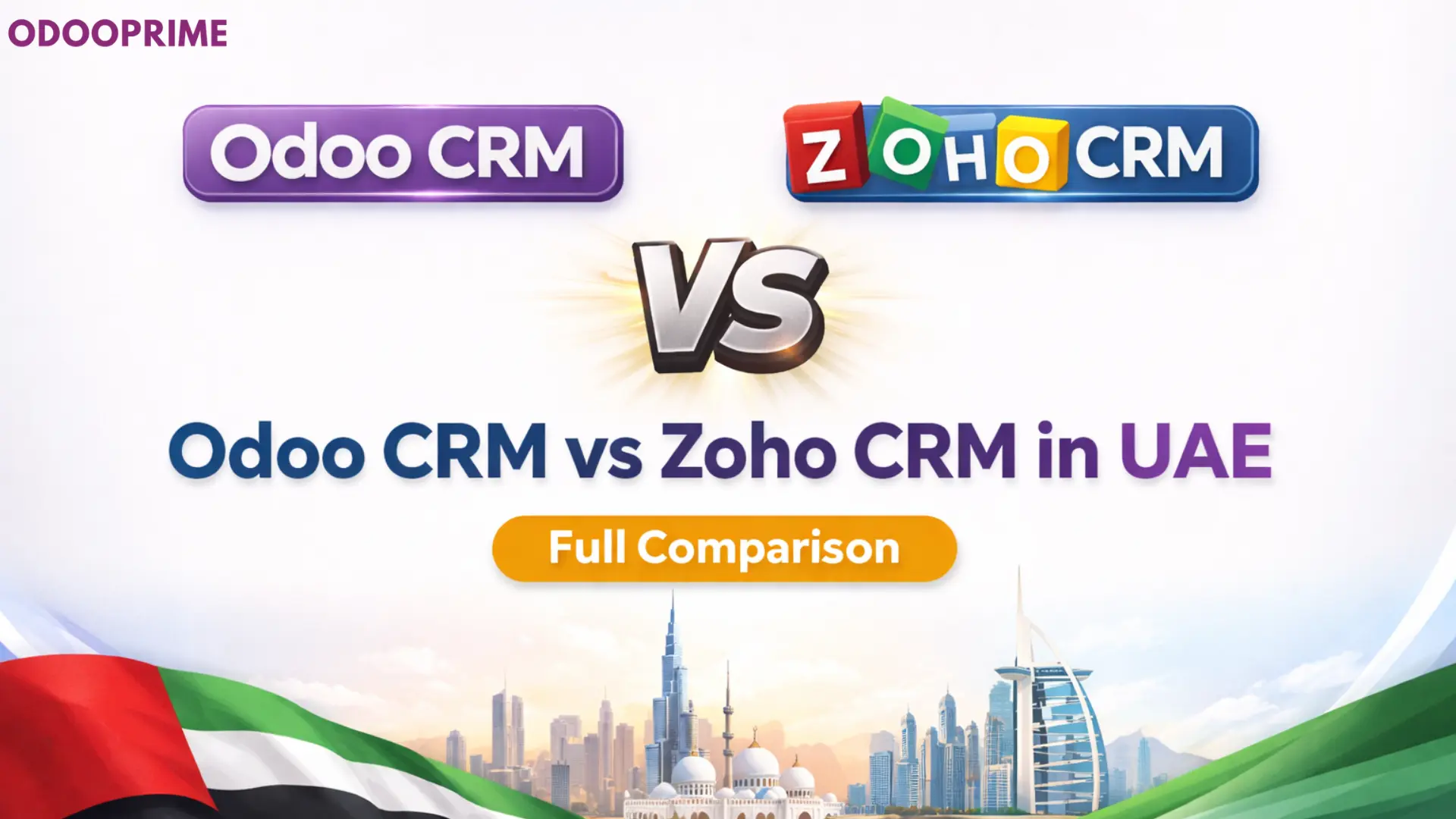
Overview of Odoo CRM vs Zoho CRM in UAE
Odoo CRM and Zoho CRM are widely used in the UAE business market.
Both systems support customer management, sales tracking, and automation.
The main difference lies in system structure.
Odoo CRM is part of a complete ERP ecosystem.
Zoho CRM is a standalone cloud-based CRM platform.
In the UAE, businesses focus on scalability, VAT compliance, and integration with accounting systems.
Odoo fits companies that want one system for CRM, accounting, inventory, HR, and operations.
Zoho focuses mainly on sales and marketing workflows.
Odoo allows deeper customization for industry-specific needs in Dubai and Abu Dhabi.
Zoho offers faster setup but limited ERP-level integration.
Companies in logistics, construction, retail, and manufacturing often prefer Odoo due to unified operations.
Service-based SMEs may prefer Zoho for quick deployment.
Choosing between them depends on business size, budget, and integration needs.
For companies seeking full ERP + CRM control, Odoo becomes a stronger long-term option.
Key Features Comparison
Odoo CRM Features
Odoo CRM provides a structured sales pipeline system.
It includes lead management, opportunity tracking, and automated follow-ups.
Users can connect CRM directly with sales, invoicing, and inventory modules.
This reduces manual data entry and duplication.
Odoo supports custom workflows for different UAE industries.
Dashboards offer real-time visibility of sales performance.
Email integration and communication tracking are built-in.
The system allows full customization without heavy third-party tools.
Odoo CRM also supports multi-company and multi-currency operations.
This is useful for UAE-based firms working across GCC markets.
Integration with accounting ensures faster invoice generation.
Businesses can also link CRM data with HR and project management.
This makes Odoo a complete operational system beyond CRM.
Zoho CRM Features
Zoho CRM focuses on sales automation and customer engagement.
It includes lead scoring, workflow automation, and email marketing tools.
The system is easy to deploy with minimal technical setup.
It supports AI-based sales insights and reporting.
Zoho integrates with other Zoho apps like Books and Desk.
However, integration depth is limited compared to ERP systems.
Customization is available but within platform boundaries.
It is suitable for small teams and fast-growing startups.
Zoho CRM supports cloud accessibility across devices.
It provides basic pipeline tracking and deal management.
Advanced enterprise operations may require additional tools.
This increases dependency on multiple subscriptions.
Pricing and Cost Structure in UAE
Odoo Pricing Model
Odoo uses a modular pricing system.
Businesses pay based on selected applications and users.
This makes it flexible for scaling companies in the UAE.
Initial setup cost depends on customization level.
Implementation through an official partner ensures proper configuration.
Odoo can reduce long-term cost by combining multiple systems.
Instead of separate tools, one ERP handles all operations.
This reduces integration and subscription overhead.
Companies working with an Odoo ERP partner in Dubai gain structured deployment support.
Costs may increase during customization but stabilize long-term.
Zoho Pricing Model
Zoho CRM follows a tiered subscription model.
Plans are based on features and user count.
Entry-level pricing is lower than ERP systems.
Advanced features require higher-tier subscriptions.
Add-ons may increase total monthly cost.
Zoho remains affordable for startups in UAE.
However, scaling businesses may need multiple Zoho applications.
This can increase overall ecosystem cost.
Pricing is predictable but less flexible than Odoo modular system.
Implementation and Integration
Odoo Deployment Process
Odoo implementation starts with business requirement analysis.
Modules are selected based on operations.
CRM is integrated with accounting, sales, and inventory.
Customization is often required for UAE compliance needs.
Data migration is handled during setup.
Training is provided for internal teams.
Implementation time depends on complexity.
ERP-level integration ensures unified workflows.
Partner support improves system stability.
Long-term maintenance includes updates and module expansion.
Zoho Deployment Process
Zoho CRM setup is faster and cloud-based.
Users can start with basic configuration quickly.
Importing contacts and leads is straightforward.
Automation rules are set using built-in tools.
Integration with third-party apps is available but limited.
Customization is lighter compared to ERP systems.
Minimal technical support is required during setup.
Scaling may require additional Zoho products.
This increases dependency on ecosystem tools.
It is suitable for companies needing quick CRM deployment.
Industry Use Cases in UAE
SMEs in UAE
Small and medium businesses in UAE prefer flexible CRM tools.
Zoho CRM fits startups due to fast setup and lower cost.
It helps manage leads and sales pipelines efficiently.
However, SMEs planning long-term growth often shift to Odoo.
Odoo supports scaling without system migration.
It connects sales with accounting and inventory.
This reduces operational complexity.
Businesses in retail, logistics, and services benefit from integration.
Unified data improves decision-making speed.
Large Enterprises
Large enterprises in UAE require full system integration.
Odoo CRM supports multi-department workflows.
It connects HR, finance, and operations in one platform.
This improves efficiency across teams.
Zoho CRM may require multiple tools for similar coverage.
Odoo reduces system fragmentation.
Enterprises gain better control over reporting and compliance.
It also supports multi-branch and multi-country operations.
This is important for UAE-based regional companies.
Why Odoo CRM is Strong in UAE Market
ERP Integration Advantage
Odoo CRM stands out due to ERP integration capability.
It connects CRM with accounting, inventory, HR, and projects.
This creates a single source of business data.
UAE businesses benefit from VAT-ready financial integration.
Automation reduces manual reporting errors.
Sales teams get real-time stock and pricing updates.
This improves customer response time.
Data flow between departments becomes seamless.
It supports scalability without system replacement.
Role of Odoo Partners in Dubai
Successful implementation depends on certified partners.
An experienced partner ensures correct module selection.
They configure systems based on UAE regulations.
Customization is aligned with business workflows.
Companies working with an Odoo ERP partner in Dubai gain faster deployment and stable system performance.
Support includes updates, training, and optimization.
Partners also help integrate third-party tools.
This reduces implementation risks.
It ensures long-term CRM and ERP efficiency.