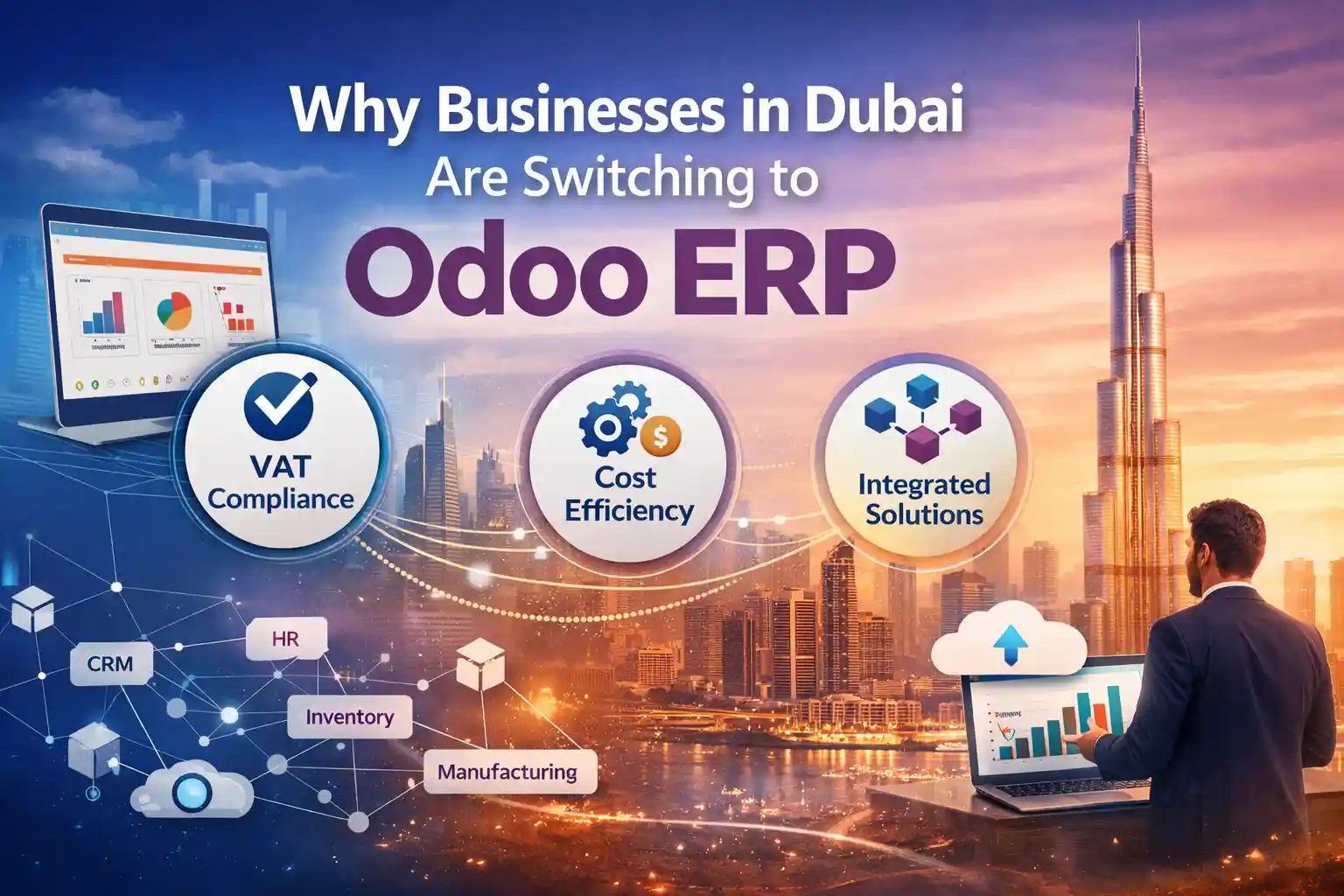
VAT compliance is mandatory for businesses operating in the United Arab Emirates.
Companies must calculate VAT, record transactions, and submit tax returns to the Federal Tax Authority.
Manual accounting increases the risk of errors.
ERP platforms like Odoo reduce that risk by automating tax processes.
This guide explains how VAT automation works in Odoo and how UAE companies can benefit from it.
VAT Compliance Requirements in UAE
VAT was introduced in the UAE in 2018 with a standard rate of 5%.
Businesses exceeding the mandatory registration threshold must register for VAT and submit tax returns regularly.
Companies must maintain accurate records including:
VAT on sales (output tax)
VAT on purchases (input tax)
tax invoices
VAT returns
audit records
Failure to comply can result in penalties.
Manual spreadsheets increase risk.
Accounting errors may occur when:
tax codes are applied incorrectly
VAT is calculated manually
transaction data is missing
Many companies still rely on manual tools, such as a vat calculator in uae for quick estimates.
However, these tools do not integrate with accounting systems.
ERP automation solves this problem.
Odoo integrates accounting, invoicing, and reporting into one system.
This ensures every transaction automatically includes the correct tax configuration.
Common VAT Compliance Challenges
Many businesses struggle with VAT management due to operational complexity.
Typical problems include:
Incorrect VAT classification
Different goods and services may have different tax treatments.
Manual systems often apply the wrong tax code.
Missing documentation
Tax invoices and purchase records must be stored correctly for audits.
Time-consuming reporting
VAT returns require accurate calculations across hundreds or thousands of transactions.
Automation solves these issues by embedding VAT logic directly into the accounting workflow.
What is VAT Automation in Odoo?
VAT automation in Odoo refers to the automatic calculation, recording, and reporting of VAT during business transactions.
The system applies tax rules automatically when users create:
invoices
purchase orders
bills
expense entries
Each transaction includes the correct VAT amount.
The accounting module records both input and output tax.
This removes manual calculations.
Automation also ensures compliance with UAE tax regulations.
Businesses can generate VAT reports instantly using real-time accounting data.
The result is faster tax preparation and fewer accounting mistakes.
Automated Tax Configuration
Odoo allows businesses to configure VAT rules once.
After setup, the system automatically applies those rules.
Configuration typically includes:
VAT rates (5%, zero-rated, exempt)
tax groups
fiscal positions
invoice tax mapping
Once configured, users simply create invoices.
The ERP system calculates tax automatically.
This standardization ensures every department follows the same tax rules.
Key Features of Odoo VAT Automation
Odoo provides several tools that support automated VAT accounting.
These features reduce manual effort and improve reporting accuracy.
Key capabilities include:
automatic VAT calculation
real-time accounting entries
automated tax reports
VAT return preparation
multi-company VAT management
Finance teams can monitor tax obligations without manually compiling spreadsheets.
Automation also supports audit readiness.
All tax records remain stored inside the ERP database.
Integrated Accounting System
The accounting module is the core of VAT automation.
Every financial transaction connects to the general ledger.
This integration provides several advantages:
instant tax calculations
automatic journal entries
accurate financial reporting
Sales invoices automatically generate output VAT entries.
Purchase bills generate input VAT entries.
This ensures tax amounts remain balanced.
How Odoo Automates VAT Calculations
VAT automation begins when a transaction is recorded.
For example, when a sales invoice is created.
Odoo checks the configured tax rules.
The system then calculates the VAT amount automatically.
The invoice displays both:
net amount
VAT amount
total payable
Simultaneously, the ERP system records the accounting entries.
This removes the need for manual tax calculations.
Businesses gain accurate financial data in real time.
Example VAT Workflow
A simple transaction demonstrates how automation works.
A company sells goods worth AED 10,000.
The system applies the 5% VAT rule.
Odoo calculates AED 500 VAT automatically.
The invoice total becomes AED 10,500.
The accounting module records VAT payable.
This entire process occurs instantly.
No manual calculations are required.
Benefits of VAT Automation for UAE Businesses
VAT automation improves both compliance and operational efficiency.
Companies gain several advantages.
Reduced accounting errors
Automated tax calculations minimize mistakes caused by manual data entry.
Faster reporting
Finance teams can generate VAT reports in seconds.
Improved compliance
Automation helps businesses follow regulations from the Federal Tax Authority.
Better financial visibility
Real-time dashboards display VAT liabilities and tax credits.
Lower administrative workload
Accountants spend less time on repetitive calculations.
Automation allows finance teams to focus on strategic tasks.
Cost Savings Through Automation
Manual VAT processing increases operational costs.
Businesses often spend hours preparing tax reports.
ERP automation reduces this effort.
Key cost savings include:
fewer accounting hours
reduced compliance penalties
improved audit preparation
Companies also gain better financial control.
Automated systems reduce dependency on manual spreadsheets.
How to Configure VAT in Odoo for UAE
VAT configuration is an important step when implementing Odoo.
The system must reflect UAE tax rules.
Typical setup steps include:
Enable the accounting module.
Configure tax rates such as 5%, zero-rated, and exempt.
Create tax groups for reporting.
Assign VAT rules to products and services.
test invoice transactions.
After setup, VAT automation runs automatically.
Businesses should ensure the configuration matches their industry requirements.
Best Practices for VAT Setup
To maintain accurate VAT records, companies should follow best practices.
Review tax mapping regularly
Changes in products or services may require updated tax rules.
Train accounting staff
Employees should understand how VAT works inside the ERP system.
Perform monthly checks
Review VAT reports before filing returns.
These practices help maintain long-term compliance.
VAT Reporting and Return Filing in Odoo
VAT reports are generated directly from accounting data.
This eliminates manual compilation.
The reporting dashboard includes:
VAT summary
tax payable
input tax recovery
transaction breakdowns
Finance teams can export reports in spreadsheet format for submission.
The system also helps businesses review tax records before filing returns.
This reduces the risk of errors.
Companies can also maintain full audit trails.
Every transaction remains linked to invoices and purchase records.
VAT Audit Readiness
Businesses must maintain records for tax inspections.
Odoo stores all accounting documents inside the system.
This provides several benefits:
easy document retrieval
transaction traceability
accurate tax records
During audits, companies can quickly provide required data.
This improves transparency and complian
Choosing the Right Odoo Implementation Partner
VAT automation works best when the ERP system is configured correctly.
Implementation expertise is essential.
Businesses should work with an experienced Odoo Service Provider in Dubai.
A qualified partner can help with:
VAT configuration
accounting setup
ERP customization
staff training
Proper implementation ensures the system meets UAE tax regulations.
It also helps businesses use the full capabilities of Odoo.
Conclusion
VAT compliance is a critical requirement for companies operating in the United Arab Emirates.
Manual tax calculations increase risk and consume time.
VAT automation in Odoo simplifies the entire process.
Businesses gain:
accurate VAT calculations
faster reporting
improved compliance
reduced accounting workload
For growing companies in the UAE, ERP automation is no longer optional.
It is a practical step toward efficient financial management and reliable tax reporting.